Most small businesses have sent a promotional email before.
A holiday sale. A new product announcement. A reminder about an event. A quick “we’re offering 20% off this week” message.
That kind of one-time promotion can be useful, but it is not the same thing as a campaign.
A campaign is a planned sequence of messages designed to move a specific audience toward a specific action. Instead of sending one message and hoping it works, you think through the goal, the audience, the timing, the offer, the call-to-action, and the follow-up. Each message has a role to play.
That may sound like something only large companies or marketing agencies do. It is not. In fact, small businesses often benefit the most from a good campaign because they cannot afford to waste attention. Every email or text message should have a purpose.
The Difference Between a Message and a Campaign
A single promotional email says, “Here is something we want you to know.”
A campaign says, “Here is the path we want the customer to take.”
For example, a single email might announce a spring tune-up special for an HVAC company. A campaign might include:
- An initial email explaining why spring maintenance matters
- A follow-up email showing what is included in the service
- A short SMS reminder before the offer expires
- A final “last chance” email with a clear booking link
- A thank-you or post-service follow-up message
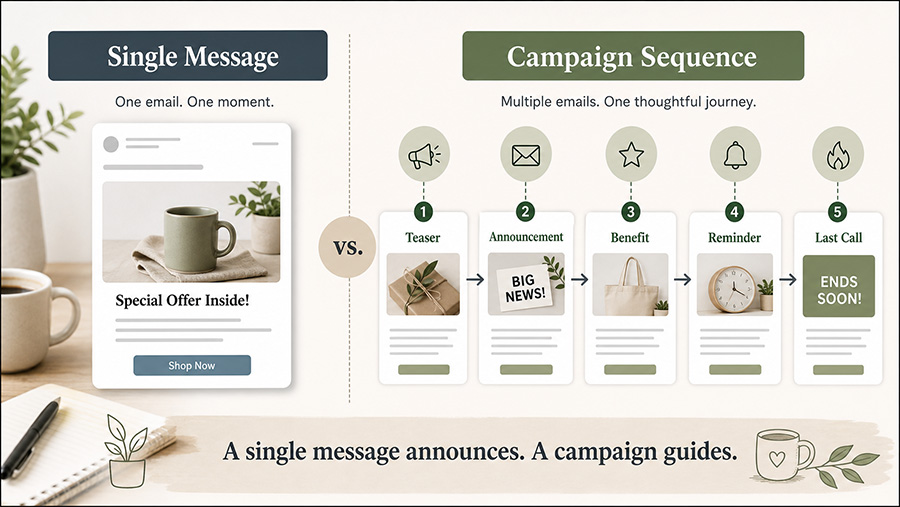
Each message builds on the previous one. The customer is not expected to act the first time they hear from you. The campaign gives them a few chances to understand the offer, consider it, and respond.
That structure is especially important because most people are busy. They may see your first email but not open it. They may read your text but not be ready to act. They may need one more reminder before they schedule, buy, register, or reply.
A campaign respects that reality.
Start With the Goal
Before writing subject lines, SMS messages, or promotional copy, define the goal.
Not a vague goal like “get more business.” A useful campaign goal is more specific:
- Book 25 appointments for a seasonal service
- Get inactive customers to place another order
- Encourage new subscribers to schedule a consultation
- Promote registration for a local event
- Introduce new customers to the next steps after purchase
- Collect feedback after a completed project
The goal shapes everything else. A campaign designed to re-engage past customers should feel different from a campaign welcoming new subscribers. A product launch campaign should not have the same rhythm as a survey request.
This is why campaign type matters. A welcome series, nurture sequence, event campaign, onboarding flow, promotional launch, post-purchase campaign, and re-engagement campaign all have different jobs.
If you are not sure what type of campaign you need, ask yourself: “What situation is the customer in right now?”
Are they new? Interested but not ready? Already a customer? Inactive? Attending an event? Considering a seasonal offer?
That answer will usually point you toward the right campaign structure.
Know Who You Are Talking To
One of the easiest ways to weaken a campaign is to aim it at “everyone.”
Everyone is not an audience. Everyone has no shared problem, no common motivation, and no obvious reason to act.
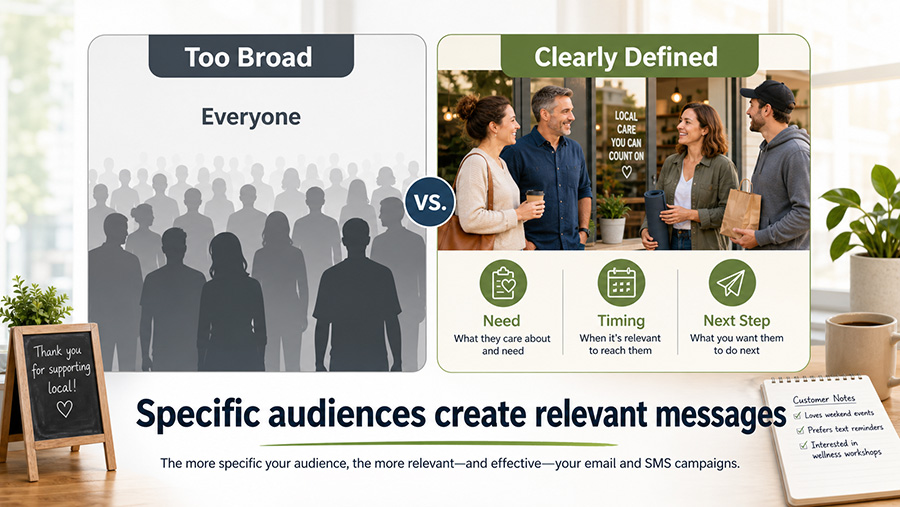
A useful target audience description includes details such as:
- Who they are
- What problem they have
- What they already know
- What they may be worried about
- What would make the offer valuable to them
- What might prevent them from taking action
For example, “homeowners” is too broad.
“Homeowners in older homes who are worried about rising energy bills and want to avoid emergency HVAC repairs” is much better.
“Small business owners” is broad.
“Local service business owners who rely on repeat customers but do not have a consistent follow-up process” gives you something to write to.
The more specific the audience, the more useful the campaign can be. Good campaigns do not just announce. They connect.
Clarify the Offer
The offer is what the customer gets or experiences if they respond.
It may be a discount, but it does not have to be. An offer can be:
- A free consultation
- A limited-time service package
- A webinar or local event
- A downloadable guide
- A new customer onboarding session
- A product bundle
- A maintenance reminder
- A loyalty reward
- A request for feedback
The key is clarity. The reader should not have to work hard to understand what is being offered or why it matters.
Weak offer: “Check out our services.”
Stronger offer: “Schedule a free 20-minute consultation to identify the fastest way to improve your website’s lead capture.”
Weak offer: “Big sale this week.”
Stronger offer: “Save 25% on spring maintenance appointments booked by Friday.”
The stronger version gives the customer something concrete to evaluate.
Decide on the Call-to-Action
The call-to-action, or CTA, is the action you want the recipient to take.
Common CTAs include:
- Schedule a consultation
- Book an appointment
- Register for an event
- Claim an offer
- Download a guide
- Visit a landing page
- Reply to the message
- Complete a survey
- Call the office
A campaign can contain supporting links and helpful information, but it should usually have one primary CTA. If a customer is asked to “book now,” “learn more,” “follow us,” “read the blog,” and “forward this to a friend” all in the same message, the result is confusion.
A clear CTA makes the next step obvious.
For email, the CTA may appear as a button or link. For SMS, it is usually a short instruction plus a link or reply option. Either way, the CTA should match the campaign goal.
If the goal is appointments, the CTA should not merely say “Learn more.” It should point toward scheduling.
Choose Email, SMS, or Both
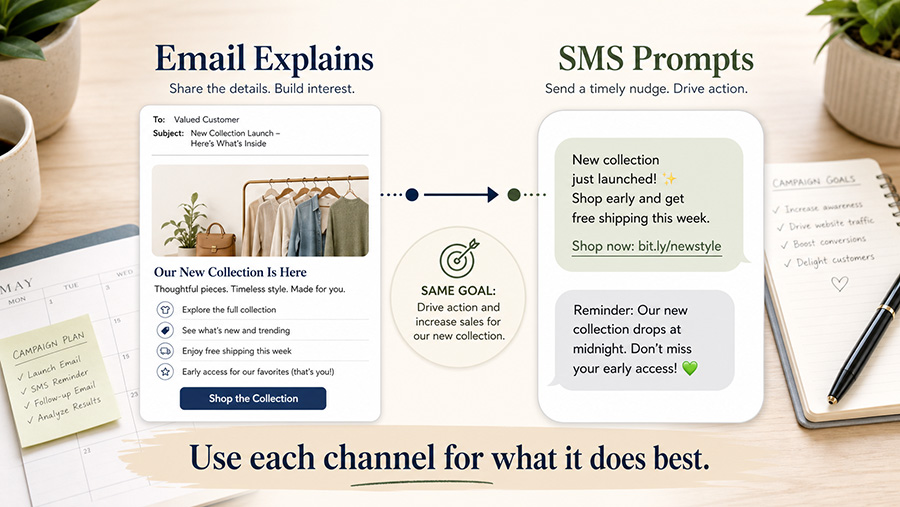
Email and SMS are different tools. They can work beautifully together, but they should not be used the same way.
Email is better for:
- Explaining details
- Telling a story
- Presenting multiple benefits
- Showing images
- Including longer context
- Delivering newsletters or educational content
SMS is better for:
- Short reminders
- Urgent updates
- Appointment confirmations
- Limited-time prompts
- Simple follow-ups
- Messages where immediacy matters
A good email can be several paragraphs. A good SMS usually cannot. Text messages need to be short, direct, and respectful of the customer’s attention.
If you use both channels, think about how they support each other. The email may explain the offer. The SMS may remind the customer before the deadline. The email may introduce an event. The SMS may send a day-before reminder.
Do not simply copy the email into a text message. That almost never works.
Build a Sequence, Not a Pile of Messages
A campaign sequence is the planned order of messages.
Each message should have a distinct role. For example, a promotional launch campaign might follow this pattern:
- Teaser: Something new is coming
- Announcement: The offer is now available
- Benefit-focused follow-up: Why it matters
- Urgency reminder: Deadline or limited availability
- Last call: Final chance to act
A welcome series might look very different:
- Welcome and thank-you
- Introduction to the business or service
- Helpful resource or next step
- Invitation to schedule, buy, or reply
A re-engagement campaign might be shorter and more direct:
- “We haven’t heard from you in a while”
- Fresh reason to return
- Final reminder or incentive
The point is not to send more messages for the sake of sending more messages. The point is to give each message a job.
Use Brand Context
This is where many AI-generated marketing messages go wrong. Without enough context, even well-written content can sound generic.
The AI may know how to write a promotional email, but it does not automatically know your business, your customers, your tone, your offer, your differentiators, or your boundaries.
Useful brand context includes:
- Company name and website
- Brand voice
- Products or services
- Customer pain points
- Past marketing plans
- Existing brochures or sales sheets
- Phrases you want included
- Language you want avoided
- Competitors or comparisons to avoid
- Tone preferences
For example, two businesses may both offer home services, but one may be a premium provider focused on white-glove service while another competes on speed and affordability. Their campaigns should not sound the same.
Specific context helps the campaign sound like it came from your business, not from a generic template.
Review the First Draft Before Generating Everything

One of the smartest ways to use an AI campaign builder is to review a small proof batch before generating the full campaign. Brainiest AI’s Email+SMS Campaign Builder offers several natural steps to provide feedback and make revisions, including a comprehensive campaign brief, a proof batch, and finally the complete campaign. You can make small revisions or revise the whole campaign. at any step, just as if you were working with a marketing agency.
This gives you a chance to catch problems early:
- The tone is too formal
- The subject lines are too long
- The SMS messages need stronger opt-out language
- The offer is not clear enough
- The CTA points to the wrong action
- The campaign misunderstood the audience
- The sequence is too aggressive or too weak
When giving feedback, be specific.
Less helpful: “I don’t like it.”
More helpful: “Make the tone warmer and less salesy. Keep the CTA focused on booking a consultation. Email #2 is good, but the SMS messages should be shorter.”
The more precise your feedback, the better the revised campaign will be.
Common Terms Explained
Campaign: A planned series of related messages designed to achieve a specific goal.
Sequence: The order and structure of the messages in the campaign.
Email template: A distinct email message created for a specific step in the campaign. This is not the number of people who receive it.
SMS template: A distinct text message created for a specific step in the campaign. Again, this is not the number of recipients.
Subject line: The headline of an email that appears in the inbox.
Preview text: The short snippet that appears near the subject line in many email inboxes.
CTA: Call-to-action. The action you want the recipient to take.
Segment: A defined group within your audience, such as new customers, inactive customers, past buyers, or event registrants.
Drip campaign: A sequence of messages sent over time, often used to educate or nurture leads.
Nurture campaign: A campaign designed to build trust and move someone gradually toward a decision.
Re-engagement campaign: A campaign designed to win back people who have stopped responding or buying.
Opt-out: A way for recipients to stop receiving future messages.
Compliance notes: Reminders about legal or platform requirements, such as unsubscribe links for email or opt-out language for SMS.
Common Mistakes to Avoid
Mistake 1: Starting with the message instead of the goal
If you start by writing “an email,” you may end up with a message that sounds fine but does not accomplish anything. Start with the outcome you want.
Mistake 2: Targeting too broad an audience
A campaign for “all customers” is usually less effective than a campaign for a specific group with a specific need.
Mistake 3: Using too many CTAs
Multiple competing actions can reduce response. Decide what matters most.
Mistake 4: Making SMS do the job of email
SMS is not a miniature newsletter. Keep it short and direct.
Mistake 5: Sending every message at the same intensity
A campaign should have a rhythm. Some messages educate. Some remind. Some create urgency. If every message feels like a final warning, customers may tune out.
Mistake 6: Forgetting compliance
Marketing emails need proper sender information and an opt-out method. SMS marketing requires special care around consent and opt-out handling. Always review compliance requirements for your business and platform before sending.
Mistake 7: Skipping review
AI can save time, but it should not remove human judgment. Review the campaign brief, assumptions, CTAs, links, tone, and compliance notes before publishing.
Do’s and Don’ts
Do: Set a specific goal
Know what action you want before you write.
Don’t: Use a campaign as a general announcement board
A campaign should move people toward a clear outcome.
Do: Describe your audience clearly
Give the campaign enough direction to sound relevant.
Don’t: Write for “everyone”
Broad campaigns often produce bland messages.
Do: Match the channel to the message
Use email for detail and SMS for short, timely prompts.
Don’t: Copy and paste email content into SMS
Text messages need their own structure.
Do: Give the AI useful brand context
Website content, brand voice, prior marketing materials, and offer details can dramatically improve the output.
Don’t: Accept generic content just because it is polished
Polished is not the same as effective.
Do: Review the proof batch carefully
Early feedback prevents bigger editing work later.
Don’t: Approve everything without checking assumptions
Make sure the campaign understood your offer, audience, and CTA.
A Simple Campaign Planning Checklist
Before building your campaign, answer these questions:
- What is the main goal?
- Who is the target audience?
- Why would this audience care?
- What is the offer or message?
- What action do we want them to take?
- Should this use email, SMS, or both?
- How many steps does the sequence need?
- What information must be included?
- What language or topics should be avoided?
- What deadline, event date, or offer detail matters?
- What will success look like?
If you can answer those questions, you are no longer just “sending an email.” You are building a campaign.
The Bottom Line
Email and SMS campaigns do not need to be complicated, but they do need to be intentional. Brainiest AI’s Email+SMS Campaign Builder can guide you through the process and give you quicker, more effective results.
A strong campaign starts with a goal, speaks to a defined audience, presents a clear offer, and guides the recipient toward a specific action. It uses email and SMS for what each channel does best. It gives each message a purpose. And it includes a human review step before anything goes out the door.
For small businesses, that structure can make the difference between another forgotten promotion and a campaign that actually moves customers to act.