
Creating a social media campaign or advertising campaign is a major step for a small business.
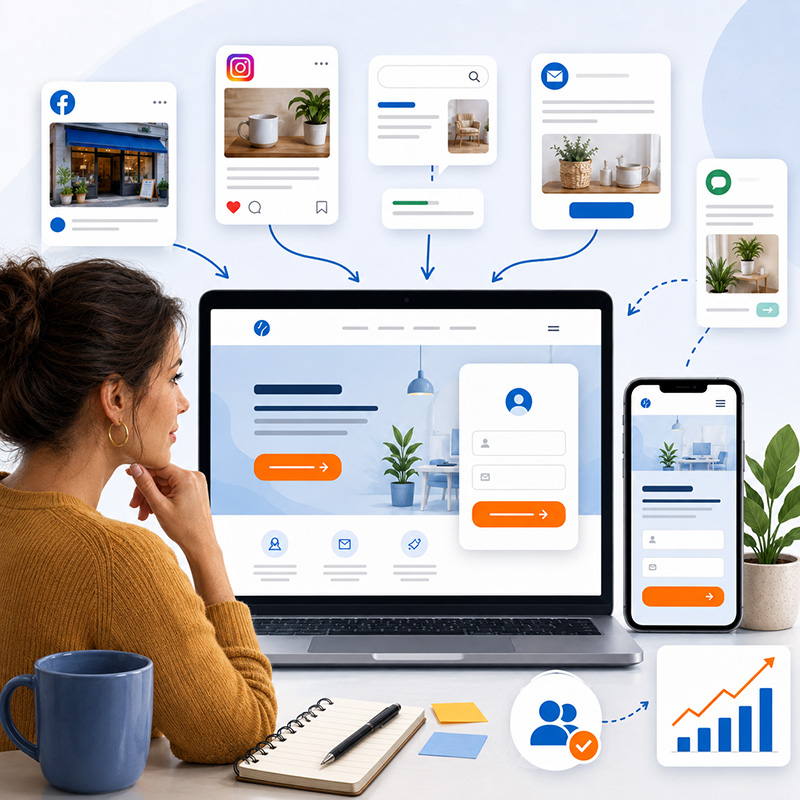
You identify the people you want to reach. You develop an offer. You create messages and images designed to capture their attention. Then you publish your posts or launch your ads and wait for prospective customers to respond.
But what happens after someone clicks?
Too often, the answer is that they are sent to the company’s homepage.
A homepage may seem like the obvious destination. It introduces your business, describes your services, and gives visitors several ways to explore your website. Unfortunately, those same qualities can make it a poor destination for campaign traffic.
Your homepage is designed to serve many audiences and answer many questions. A landing page is designed to help one particular audience take one particular action.
That difference can determine whether the attention generated by your campaign turns into a new customer—or disappears after a few seconds.
What Is a Landing Page?
A landing page is a webpage created for a specific marketing campaign, offer, or audience.
It is called a landing page because it is where people “land” after clicking a social media post, online advertisement, promotional email, text message, or other campaign link.
Unlike a typical website page, a landing page usually has a single primary purpose. That purpose might be to encourage visitors to:
- Request a consultation
- Schedule an appointment
- Register for an event
- Download a guide
- Join an email list
- Call the business
- Request a quote
- Purchase a product or service
Everything on the page supports that next step.
A landing page does not need to be complicated. It simply needs to continue the conversation started by the campaign and make it easy for an interested visitor to respond.
Why Your Homepage Is Usually Not Enough
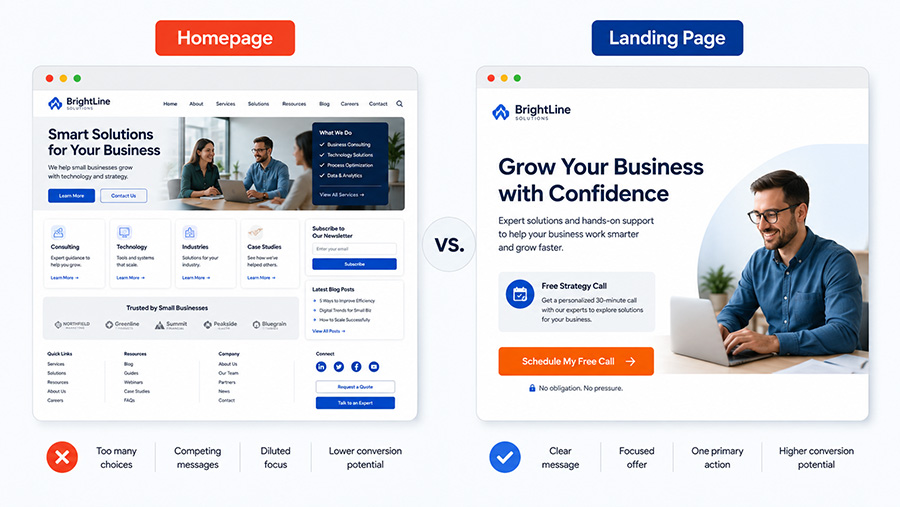
Imagine that you see an advertisement from a landscaping company offering a spring yard cleanup package.
You click the ad because the offer sounds useful. Instead of arriving on a page that explains the package, price, availability, and next steps, you are sent to the company’s homepage.
The homepage welcomes you to the business. It describes lawn maintenance, irrigation repair, tree trimming, landscape design, and several other services. It includes links to an About page, photo gallery, blog, and contact page.
The information may be helpful, but the spring cleanup offer that attracted your attention is difficult to find.
You must now search for it, determine whether it is still available, and decide how to request it. Every additional step gives you another opportunity to become distracted, confused, or simply leave.
A landing page removes that friction.
It would greet you with a headline about the spring cleanup offer, explain what is included, show the results you can expect, answer likely questions, and provide a clear button to request an estimate.
The visitor does not need to figure out what to do next. The page guides them there.
A Landing Page Keeps the Promise Made by Your Campaign
Every effective campaign makes a promise.
An advertisement might promise a simpler way to manage payroll. A social media post might promise an easier family dinner. An email might invite customers to an upcoming workshop.
When someone clicks, the destination page should immediately confirm that they are in the right place.
The headline, image, offer, and tone should feel like a natural continuation of the message they just saw. Marketing professionals sometimes call this “message match,” but the idea is straightforward: the page should deliver what the campaign promised.
When the campaign and landing page feel disconnected, visitors may wonder whether they clicked the wrong link. When they work together, the visitor can continue moving forward without hesitation.
A Landing Page Focuses Attention on One Next Step
Most business websites offer many possible paths. Visitors can read about the company, browse services, view products, read articles, or follow links to social media.
That flexibility is useful when someone is casually exploring your business. It is less useful when someone has responded to a specific offer.
A landing page reduces the number of decisions the visitor must make. Instead of asking, “Where should I go from here?” the visitor is presented with a clear next step.
That action is usually expressed through a call to action, often abbreviated as CTA.
Examples include:
- Schedule My Free Consultation
- Request an Estimate
- Reserve My Seat
- Download the Guide
- Start My Free Trial
- Call for Availability
A clear call to action does not pressure the visitor. It helps an interested person act on that interest.
A Landing Page Gives You Room to Make Your Case
A social media post or online advertisement must communicate quickly. Space is limited, attention is short, and the message must compete with everything else on the screen.
A landing page gives you room to explain why the offer matters.
Depending on the campaign, the page might include:
- A clear description of the problem you solve
- The benefits of your product, service, or offer
- An explanation of how the process works
- Images or videos showing the product or outcome
- Authentic customer testimonials
- Answers to frequently asked questions
- Details about pricing, eligibility, timing, or availability
- A form, phone number, or button for taking action
The page can address the questions and concerns that might otherwise prevent someone from responding.
This is especially important when the visitor is unfamiliar with your company. They may be interested in the offer but still need reassurance before contacting you.
Landing Pages Help You Learn What Works
A campaign should do more than generate activity. It should help you understand what motivates your audience.
When campaign traffic is sent to a dedicated landing page, it becomes easier to evaluate the campaign’s performance.
You can measure how many people visited the page and how many completed the desired action. You can also create different versions of a page to compare headlines, images, offers, or calls to action.
For example, a consultant might test two different offers:
- Schedule a Free 20-Minute Consultation
- Request a Free Business Assessment
Both may appeal to the same audience, but one may generate substantially more responses. Without a dedicated landing page, that difference can be difficult to see.
Over time, these lessons can improve not only the landing page, but also future ads, social posts, emails, and offers.
Ensure Your Landing Page Works
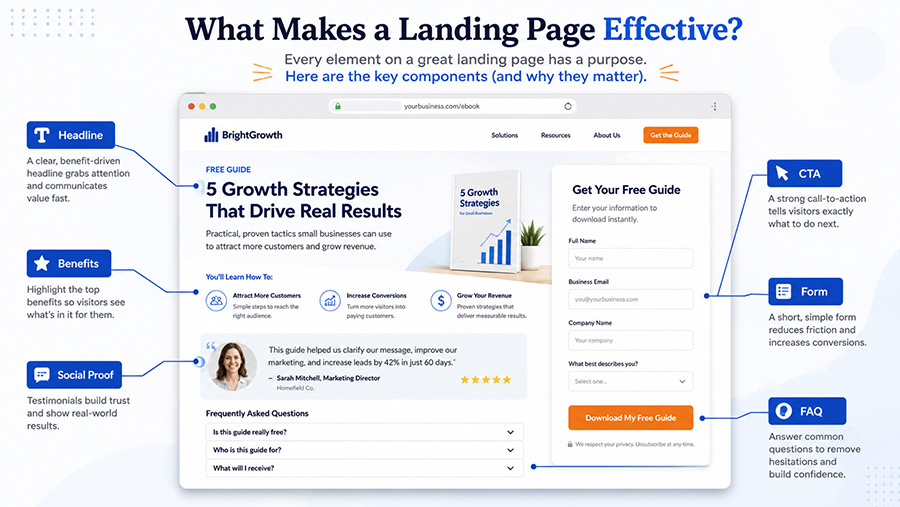
There is no single layout that works for every campaign, but effective landing pages usually share several characteristics.
A Clear Headline
The headline should quickly tell visitors what the page is about and why it is relevant to them.
A visitor should not need to study the page to understand the offer.
A Strong Connection to the Campaign
The page should reflect the message, imagery, audience, and offer used in the campaign that brought the visitor there.
A Clear Explanation of the Value
The page should focus on the benefits the customer will receive, not simply list the features of the product or service.
A Visible Call to Action
Visitors should be able to quickly identify what they are being invited to do. On longer pages, the call to action may appear in several places.
Helpful Proof
Real testimonials, reviews, examples, credentials, or results can reassure visitors that your business can deliver what it promises.
Any proof you include should be authentic and verifiable. A sincere comment from a real customer is far more valuable than an impressive-sounding quotation that cannot be confirmed.
Answers to Likely Questions
A short FAQ section can address common concerns about price, timing, qualifications, service areas, cancellations, or what happens after someone responds.
A Good Mobile Experience
Many people who click social media posts, advertisements, emails, or text messages will arrive on a phone. The page should be easy to read and use on a small screen.
Forms should be simple, buttons should be easy to tap, and important information should not require excessive scrolling or zooming.
Different Campaigns Need Different Landing Pages
The right landing page depends on what you are asking visitors to do.
A local service business offering free estimates may need a focused page with a short explanation, a few examples of its work, and a simple contact form.
A consultant promoting a complex service may need a longer page that explains the problem, outlines the approach, describes the benefits, answers questions, and invites the visitor to schedule a conversation.
An organization promoting an event may need a page featuring the date, location, speakers, agenda, and registration button.
The goal is not to make every landing page as long or elaborate as possible. The goal is to provide enough information for the visitor to confidently take the next step.
Avoid Common Mistakes
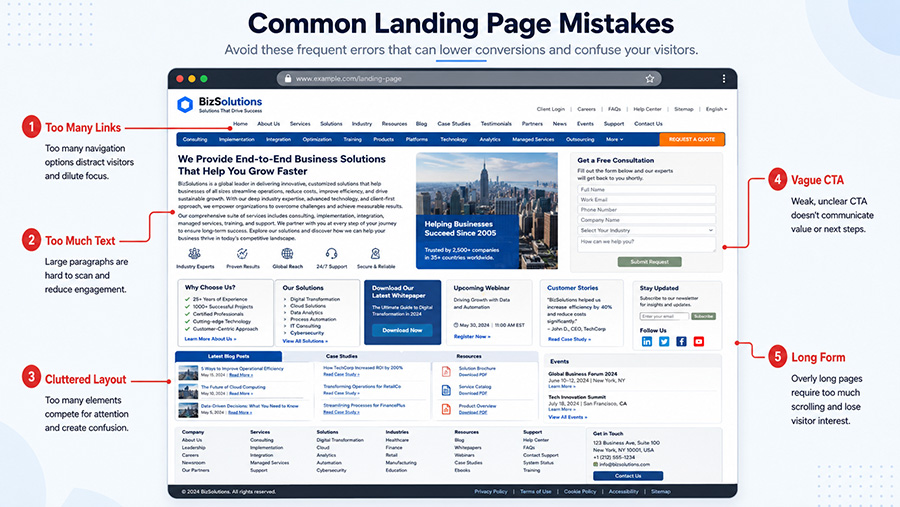
For many small businesses, simply creating a dedicated landing page is a meaningful improvement. However, several common mistakes can reduce its effectiveness.
Trying to Promote Everything at Once
A landing page should support a specific campaign. Adding unrelated services, offers, and links can distract visitors from the reason they clicked.
Using a Vague Call to Action
Buttons labeled “Submit” or “Learn More” provide little information. A more specific label, such as “Request My Free Estimate,” makes the next step clearer.
Asking for Too Much Information
A visitor may be willing to provide a name and email address to download a guide but unwilling to complete a lengthy questionnaire. Ask only for the information you genuinely need at that stage.
Focusing Entirely on the Business
Visitors are primarily interested in their own needs. A page that talks only about the company’s history, capabilities, and accomplishments may fail to explain what the customer will gain.
Publishing Without Reviewing
A landing page should always be checked for inaccurate claims, broken links, incorrect phone numbers, placeholder text, and problems on mobile devices.
Treating the Page as a One-Time Project
Your first landing page does not need to be perfect. Review its performance, learn from the results, and improve it over time.
The Landing Page Is Part of the Campaign, Not an Afterthought
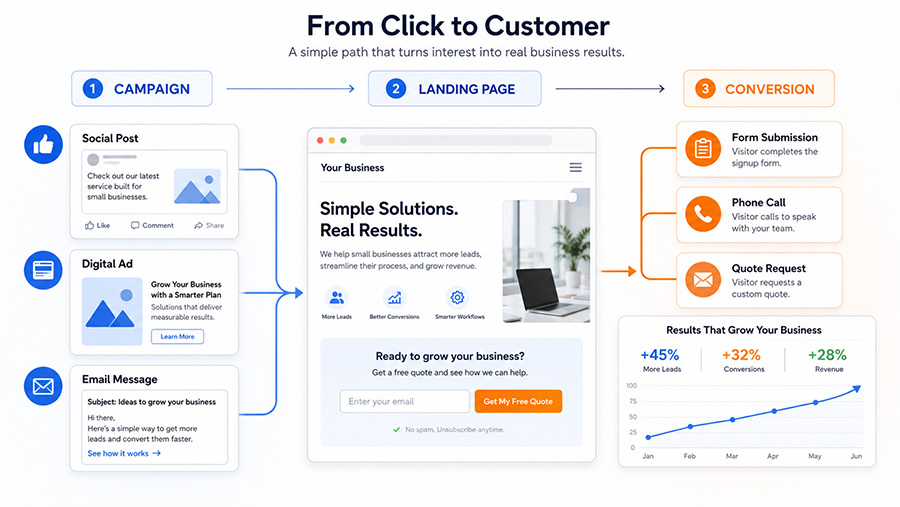
A campaign does not end when a person clicks an advertisement or social media post.
The click is a sign of interest. The landing page is where that interest has an opportunity to become action.
Ideally, the campaign and landing page should be planned together. The same audience, offer, message, images, and brand voice should flow through both.
That is one reason our Landing Page Builder begins with an existing campaign rather than asking you to start with a blank page. It can use the campaign strategy, audience, messaging, visual assets, and the knowledge our platform has developed about your company to create an editable landing page tailored to the campaign.
You can then review the content, replace or add images, refine individual sections, preview the page on desktop and mobile devices, and export the completed page as HTML.
The technology makes creating the page easier, but your knowledge of your customers remains essential. You decide whether the offer is compelling, whether the claims are accurate, and whether the page answers the questions your customers are most likely to ask.
Give Interested Visitors a Clear Path Forward
Social media posts and advertisements are useful for attracting attention, but attention alone rarely produces a business result.
After someone notices your message, they need somewhere useful to go.
A well-designed landing page continues the conversation, explains the value of your offer, answers important questions, and shows the visitor exactly how to take the next step.
For a small business running its first organized campaign, that may be the difference between generating clicks and generating customers. Subscribe to Brainiest AI to get started, and we’ll show you how.