
Artificial intelligence can generate marketing content in seconds. That is impressive.
But effective marketing has never been just about producing words quickly.
A good campaign reflects a real understanding of the business behind it: who the company serves, what makes it different, how its customers think, what objections prospects have, what offers have worked before, what tone sounds authentic, and what messages should be avoided.
That kind of understanding does not come from a one-sentence prompt. It usually does not come from a quick scan of a website, either.
And that is one of the most important lessons small businesses should understand as they begin using AI for marketing: the quality of the output depends heavily on the quality of the context.
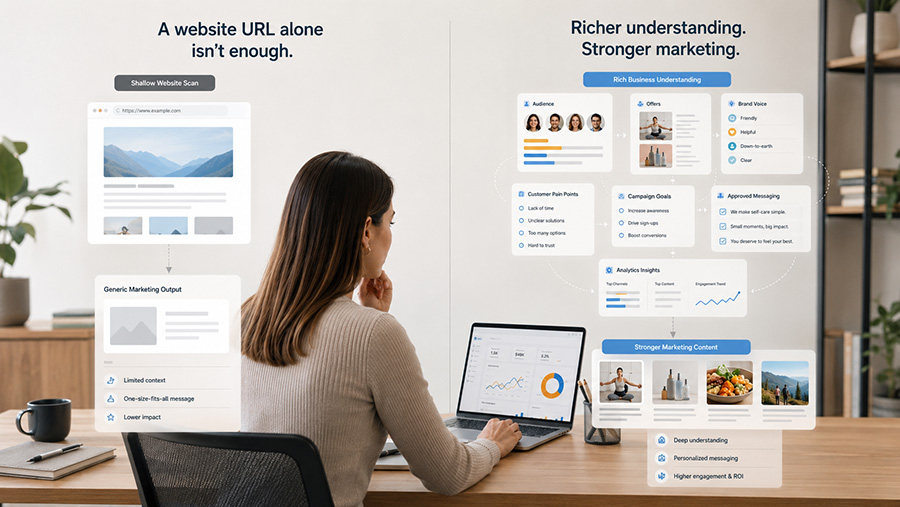
The “Just Enter Your Website URL” Problem
You have probably seen promises like this:
“Enter your website URL and we will build your entire multiweek marketing campaign.”
It sounds convenient. It also sounds plausible, especially now that AI systems can read web pages, summarize content, and generate polished copy.
But imagine hiring a marketing agency and hearing this:
“Don’t worry about telling us anything. We’ll browse your website for a few minutes and launch your campaign.”
Most business owners would be skeptical, and rightly so.
A website can provide useful clues. It may show your services, your general positioning, your contact information, and perhaps a few customer benefits. But most websites are incomplete snapshots. They rarely capture the full reality of a business.
They may not explain which services are most profitable. They may not reveal which customers are most valuable. They may not show the seasonal promotions you are planning, the objections your sales team hears every week, the tone your best customers respond to, or the messaging that has already been tested and approved.
A website can tell an AI system something about your business.
It cannot tell the whole story.
Marketing Depends on the Details
Strong marketing is rarely built from generic information. It comes from details that are specific to the business.
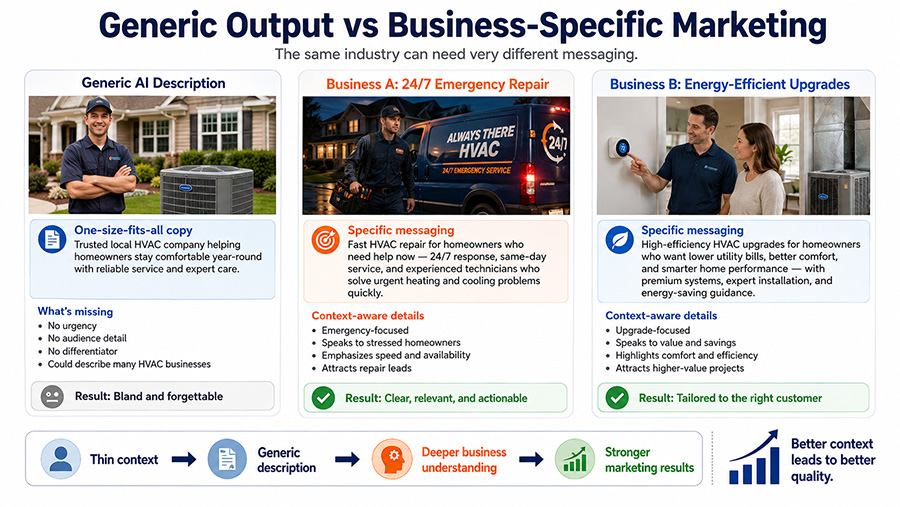
For example, two companies may both describe themselves as “family-owned HVAC contractors serving local homeowners.” On the surface, they may look similar. But the right marketing strategy could be very different.
One company may want to emphasize emergency service and fast response times. Another may want to focus on energy-efficient system upgrades. One may serve high-end homeowners who care about comfort and reliability. Another may compete on affordability and seasonal maintenance plans.
The same is true across industries.
A small law firm, a real estate agency, a dental practice, a machine shop, a boutique retailer, and a home services company may all need social posts, emails, landing pages, and blog articles. But the content should not sound interchangeable.
The best marketing reflects:
- The company’s real strengths
- The audience’s actual concerns
- The customer journey
- The current offer
- The brand voice
- Prior campaigns and messaging
- Competitive positioning
- Local or industry-specific knowledge
- Lessons from past performance
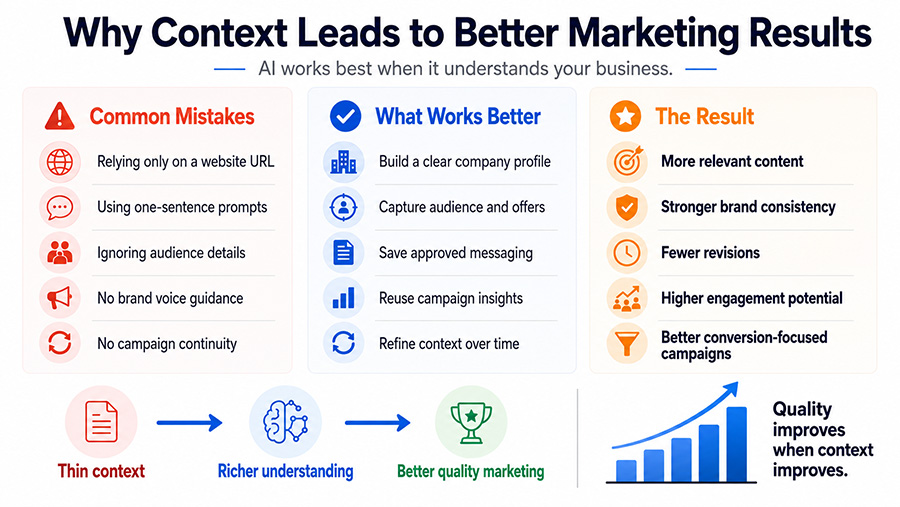
Without that context, AI may still produce fluent content. But fluent is not the same as effective.
Why AI Often Sounds Generic
Many disappointing AI marketing results have the same root cause: the AI was asked to create something without enough information.
A prompt like “Write a social media campaign for my accounting firm” may generate something that sounds reasonable. It may include tax tips, reminders about deadlines, and encouragement to schedule a consultation.
But reasonable is not necessarily strategic.
Does the firm specialize in small businesses, high-net-worth individuals, nonprofits, or contractors? Does it want more bookkeeping clients, tax planning clients, or advisory clients? Does it prefer a calm professional tone, a friendly educational tone, or a sharper expert tone? Are there services it does not want to promote? Are there compliance concerns? Has the firm already published similar content recently?
Without answers to those questions, the AI fills in the blanks with assumptions. Those assumptions may be harmless, but they may also be wrong.
That is why AI-generated marketing often sounds polished but vague. It lacks the lived-in understanding that makes content feel specific, credible, and useful.
Context Is What Turns AI From a Tool Into a Marketing Assistant
A basic AI tool responds to the prompt in front of it.
A more useful AI marketing system understands the broader business context behind the prompt.
That context may include the company profile, brand guidelines, audience definitions, product or service details, approved messaging examples, past campaign briefs, successful content, and analytics insights.
When this information is available, AI can do more than generate isolated pieces of content. It can help maintain continuity across the entire marketing effort.
A blog post can align with the same audience strategy as a social campaign. An email sequence can reinforce the same offer as a landing page. A social media calendar can avoid repeating the same points too often. A campaign can build on what has worked before instead of starting from scratch every time.
This is where AI becomes much more valuable for small businesses.
Not because it “knows everything,” but because it has access to the right business-specific knowledge at the right time.
Why Learning Over Time Matters
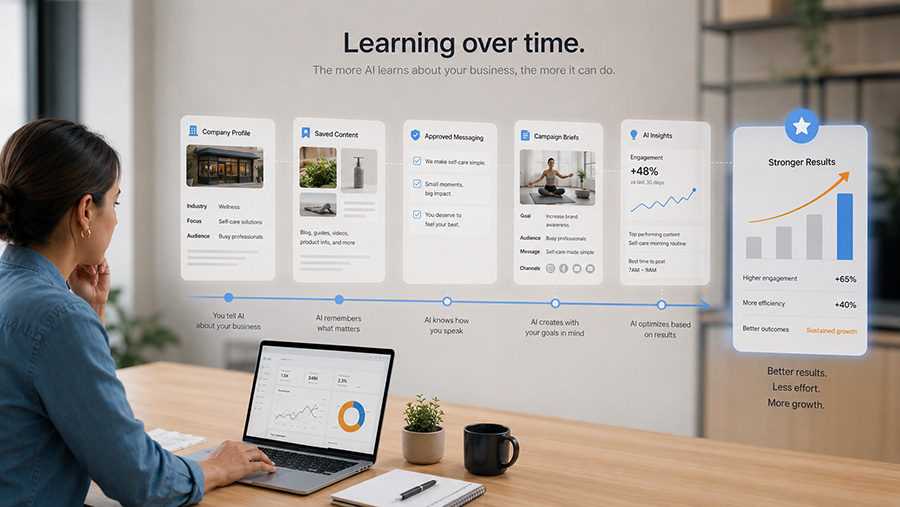
When a small business works with a good marketing agency, the relationship improves over time.
At first, the agency asks questions. It learns the business, reviews past materials, listens to customer stories, studies competitors, and gets a feel for what sounds authentic. Early work may require more review and revision.
Over time, the agency becomes more efficient. It remembers preferences. It learns what the owner likes and dislikes. It understands which offers matter most. It knows the difference between a message that is technically correct and one that actually sounds like the business.
The same principle applies to AI-powered marketing.
The first interaction can be useful. But the real value grows when the platform can carry business knowledge forward.
When a subscriber creates content, saves campaign materials, approves messaging, updates a company profile, or reviews AI-extracted insights, the platform can build a richer understanding of the business. Future outputs can then become more consistent, more relevant, and less dependent on the user repeating the same information over and over.
That is a very different experience from using AI as a blank page every time.
The Difference Between Memory and Guesswork
It is important to be careful with the word “memory.”
Good business memory should not mean that AI silently treats everything it sees as permanent truth. That would create problems. A one-time seasonal offer should not become part of the company’s long-term positioning. A draft that was never approved should not be treated as a brand guideline. An old campaign should not override a newer strategy.
Useful memory needs structure and control.
Some information is foundational: company name, industry, audience, services, geography, brand voice, preferred calls to action, and positioning.
Some information is strategic: differentiators, customer objections, successful messaging themes, and channel preferences.
Some information is campaign-specific: a seasonal promotion, a launch campaign, a local event, or a limited-time offer.
Some information is temporary and should expire or be reviewed later.
The goal is not to remember everything. The goal is to remember what is useful, retrieve what is relevant, and give users control over what should influence future content.
Why User Control Builds Trust

For business owners, trust matters.
If an AI platform is going to reuse business context, users should be able to see and manage that context. They should be able to approve useful insights, edit outdated information, pin important brand guidance, archive temporary details, and prevent certain materials from being used in the future.
This is especially important for businesses that care deeply about brand voice, regulated claims, competitive positioning, or client confidentiality.
A transparent memory system gives users confidence that AI is not operating as a mysterious black box. It also allows the business owner to improve the system over time.
In practical terms, this means the AI can become more helpful because the user is not merely giving it instructions. The user is helping shape the knowledge base that future generations rely on.
Why This Matters for Campaigns
Campaigns are where context becomes especially important.
A single social post can be somewhat generic and still be acceptable. A multiweek campaign cannot.
A real campaign needs continuity. It needs a clear objective, a defined audience, a consistent offer, a progression of messages, supporting assets, and a connection between channels. Social posts, emails, SMS messages, ads, blog articles, and landing pages should feel like parts of one coordinated effort, not disconnected pieces generated by separate prompts.
That requires memory.
The AI needs to understand the campaign brief, the offer, the intended audience, the tone, the approved messaging, and the supporting content that has already been created. It should also be able to draw on broader company knowledge so that the campaign fits the business rather than sounding like a template.
Without context, AI can generate a calendar of posts.
With context, AI can help build a campaign.
Website Scanning Still Has a Place
None of this means website scanning is useless.
A website can be a helpful starting point. It can speed up onboarding, extract basic company information, identify services, and provide clues about tone and positioning.
But a website should be treated as one source of context, not the entire foundation for a marketing strategy.
The strongest approach combines several layers of understanding:
First, the company profile provides basic business facts.
Second, saved content and approved materials show how the business actually communicates.
Third, campaign briefs provide current strategic direction.
Fourth, analytics and performance insights reveal what audiences respond to.
Fifth, user review and approval keep the memory accurate and trustworthy.
That layered approach is much closer to how a thoughtful marketing partner learns a business.
Small Businesses Deserve Better Than Generic AI
Small businesses do not need more generic content.
They need marketing that reflects who they are, what they offer, and why customers should choose them. They need tools that reduce the burden of marketing without flattening their message into the same language everyone else is using.
AI can help tremendously. It can make professional marketing support more accessible, more affordable, and more consistent. But AI works best when it is given the kind of context a human marketer would need.
A one-sentence prompt can produce a quick draft.
A website scan can produce a better draft.
A platform that learns the business over time can produce something far more useful.
The Future of AI Marketing Is Context-Aware
The next stage of AI marketing will not be defined only by faster generation or flashier images. It will be defined by systems that understand the business well enough to create connected, relevant, and trustworthy marketing materials.
For small businesses, that shift matters.
It means less time repeating the same background information. Less time correcting off-brand copy. Less time wondering why a campaign sounds generic. More consistency across channels. More continuity from one campaign to the next. More confidence that the content reflects the actual business.
AI does not replace the need for business understanding.
It makes business understanding more important.
The companies that get the best results from AI marketing will not be the ones that provide the shortest prompts. They will be the ones that give AI the right context, keep that context current, and use it to build marketing that feels specific, credible, and connected.
That is how AI moves from being a content generator to becoming a true marketing assistant.