

For many small businesses, social media marketing follows a familiar pattern.
Someone realizes the company has not posted in a while. A photo is found, a few sentences are written, and the post goes live. A few days—or perhaps a few weeks—later, the process repeats.
There is nothing inherently wrong with an occasional social media post. It can remind customers that your business exists, highlight a new product, or share an important announcement.
The problem is that isolated posts rarely work together to accomplish a larger business objective.
A single post may generate a few likes. A coordinated campaign can build awareness, educate prospective customers, reinforce your expertise, and gradually encourage people to take action.
That is the difference between simply posting on social media and running a social media campaign.
What Makes a Social Media Campaign Different?
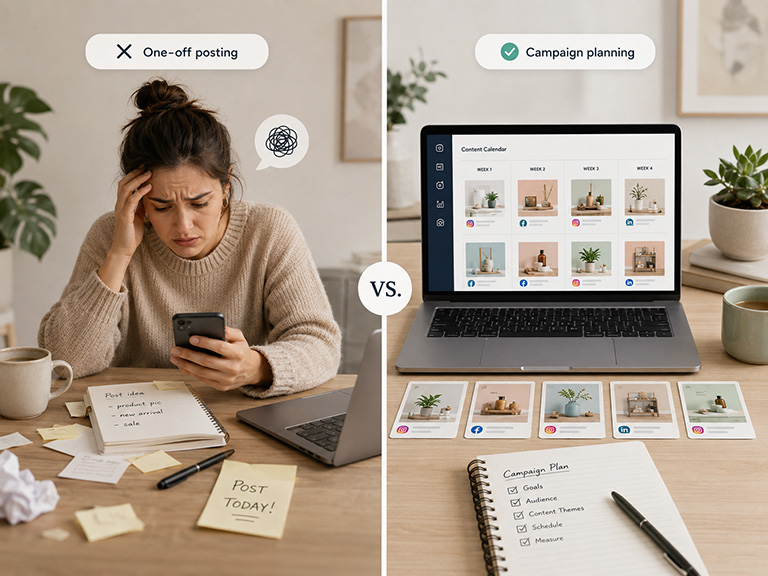
A campaign is a connected series of posts created to achieve a specific goal over a defined period.
Instead of asking, “What should we post today?” a campaign starts with more useful questions:
- What are we trying to accomplish?
- Who are we trying to reach?
- What does that audience need to hear?
- How should our message develop over time?
- What action do we ultimately want people to take?
For example, imagine that a local home-remodeling company wants to generate more kitchen renovation inquiries.
A one-off approach might produce a post showing a recently completed kitchen.
A campaign approach could include several weeks of coordinated content:
- Common mistakes homeowners make when planning a renovation
- Before-and-after project photos
- Advice for establishing a realistic budget
- Explanations of different countertop or cabinet options
- Customer testimonials
- A behind-the-scenes look at the renovation process
- Answers to frequently asked questions
- A final invitation to schedule a consultation
Each post has value on its own. Together, they tell a larger story and move prospective customers closer to contacting the company.
Why Small Businesses Often Struggle to Run Campaigns
Large companies and marketing agencies routinely build campaigns this way. They develop a strategy, create a content calendar, produce the posts and images, review the work, and schedule everything in advance.
Most small businesses do not have a marketing department available to manage that process.
The responsibility often falls to an owner, office manager, salesperson, or employee who is already handling several other jobs. They may understand their customers and business extremely well, but they may not know how to turn that knowledge into a structured social media campaign.
Even when they have good ideas, several practical challenges get in the way.
There Is No Clear Strategy
Without a defined objective, social media content can become a collection of unrelated announcements, promotions, holiday greetings, and company updates.
The posts may be perfectly acceptable, but they do not build toward a meaningful result.
Creating Enough Content Takes Time
A multi-week campaign may require dozens of captions, calls to action, hashtags, and images. Producing all of that content manually can be difficult when social media is only one of many responsibilities.
Maintaining Consistency Is Difficult
When posts are created one at a time, the tone, message, and visual style can change from week to week. Important ideas may be repeated too often, while other useful topics are overlooked.
Posting Regularly Becomes a Chore
Even after the content has been created, someone still needs to remember when and where to publish it. Social media activity often slows down as soon as the business gets busy.
Hiring an Agency May Be Too Expensive
A good marketing agency can handle the entire process, but the cost may be difficult to justify for a small business, particularly when it is just beginning to invest in social media.
A Better Process for Building a Campaign
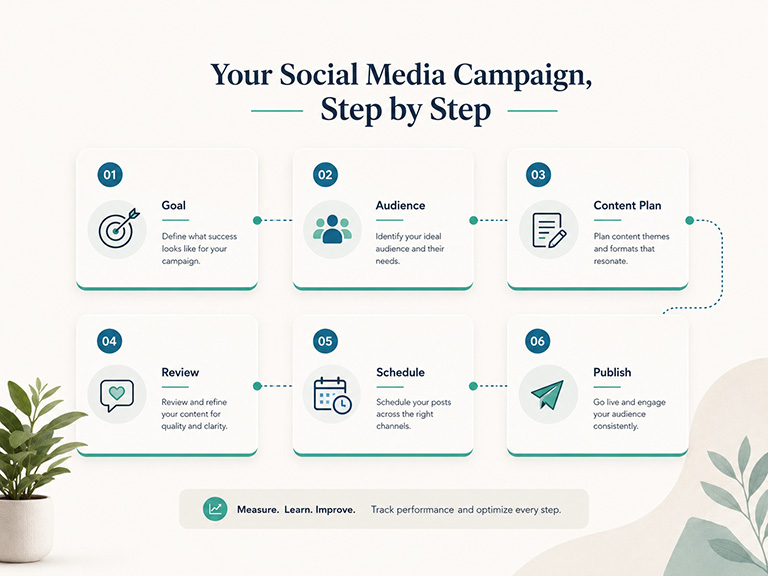
The most effective way to create a campaign is to follow a structured process similar to the one used by a marketing agency.
That process does not need to be complicated, but it should include a few essential steps.
1. Begin With a Business Objective
Every campaign should have a primary purpose.
Common objectives include:
- Increasing awareness of the business
- Generating leads
- Driving visitors to a website
- Promoting an event
- Launching a product or service
- Increasing sales or sign-ups
- Educating prospective customers
- Encouraging comments, shares, or other engagement
Choosing an objective makes it easier to decide what subjects to cover and what calls to action to include.
A campaign designed to introduce a new business will look very different from one intended to generate immediate sales.
2. Define the Audience
Trying to speak to everyone usually produces generic content that connects with no one.
A stronger campaign is built around a clearly defined audience.
Instead of targeting “people who need accounting services,” an accounting firm might focus on:
Owners of growing service businesses who are spending too much time managing invoices, payroll, and financial records.
That description gives the campaign direction. The posts can address specific concerns, demonstrate expertise, and use language that feels relevant to the intended reader.
3. Establish the Message and Tone
A good campaign should sound like it came from the same business from beginning to end.
Before creating posts, it helps to define:
- The main ideas the campaign should communicate
- Topics or claims that should be avoided
- The desired tone, such as professional, conversational, reassuring, or energetic
- Important products, services, or differentiators to mention
- Brand colors, visual preferences, and existing imagery
This information helps keep the campaign consistent without making every post sound identical.
4. Plan the Campaign Before Writing Every Post
One of the biggest advantages of a campaign is the ability to decide how individual posts will work together.
A campaign plan might begin by introducing a customer problem, then provide advice, answer questions, demonstrate expertise, present examples, and eventually invite the audience to take the next step.
Planning the sequence before writing the posts helps avoid repetition and ensures the campaign covers a useful range of topics.
5. Review the Direction Early
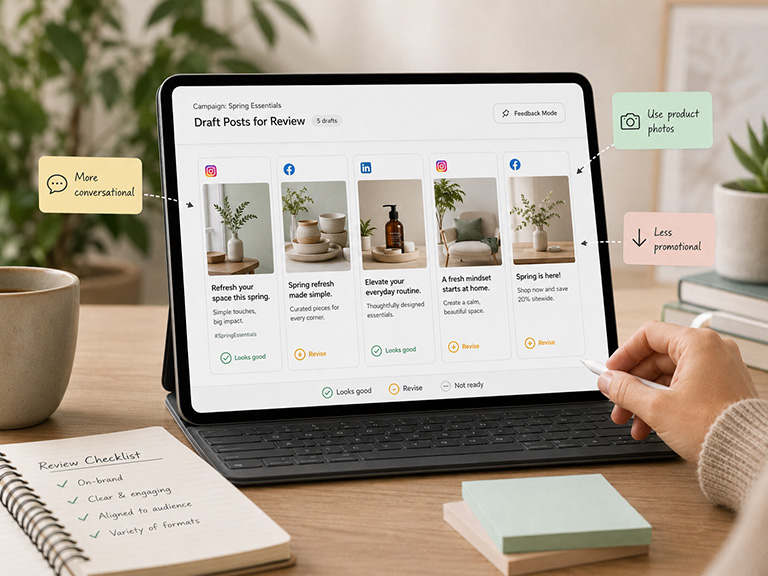
Marketing agencies rarely create an entire campaign without first confirming that the client approves of the creative direction.
A small proof batch of sample posts provides the same opportunity.
Reviewing a few posts early makes it possible to identify issues with the tone, imagery, messaging, or promotional approach before the full campaign is produced.
Feedback such as “make the tone more conversational” or “focus more on customer education and less on promotion” can improve every remaining post.
This is far more efficient than editing an entire campaign after it has been completed.
6. Review and Refine Individual Posts
Even when the overall campaign is strong, individual posts may benefit from adjustments.
A useful review process should make it possible to:
- Edit a caption directly
- Change a call to action
- Regenerate a post using specific feedback
- Replace or regenerate an image
- Add promotional text to an existing image
- Use a business’s own product, project, or customer photos
The objective is not to remove human judgment from the process. It is to give the person reviewing the campaign a strong starting point and make revisions easier.
7. Schedule the Campaign in Advance
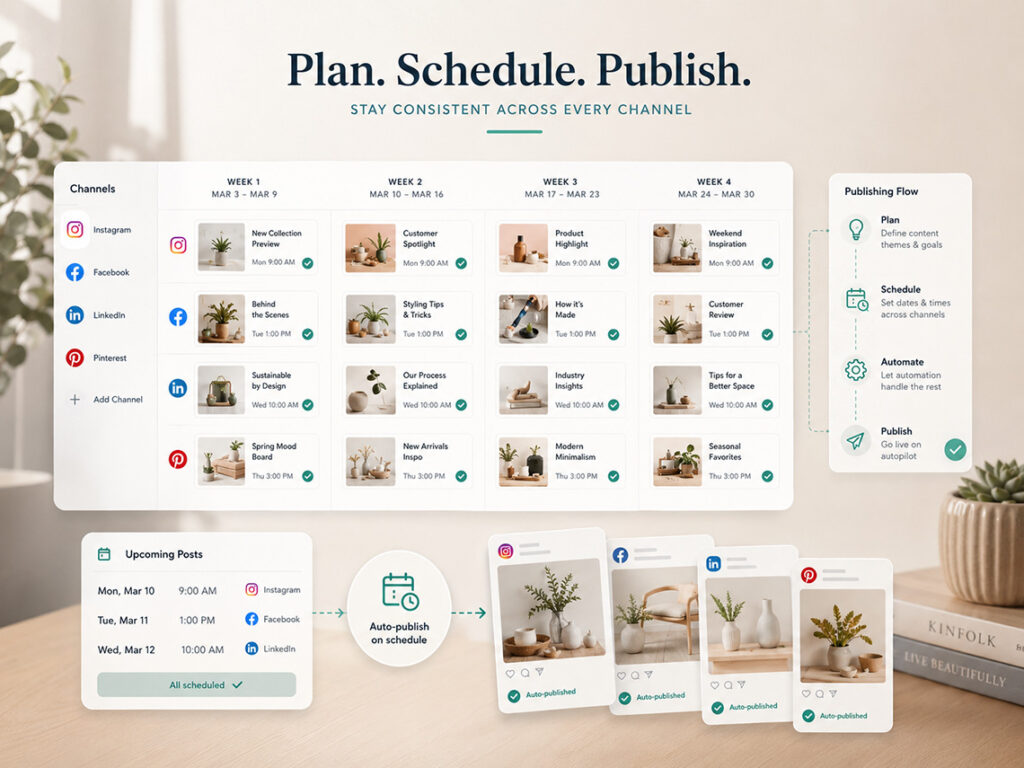
Creating good content is only part of the job. It also needs to be published consistently.
Scheduling the entire campaign in advance prevents social media activity from disappearing during busy weeks. It also makes it easier to maintain a sensible cadence rather than publishing several posts at once and then going silent.
Once scheduled, the campaign can continue running while the business focuses on serving customers.
Bringing an Agency-Style Process Within Reach
Brainiest AI’s Social Media Campaign Builder was created to guide businesses through this complete process.
Instead of beginning with an empty caption box, the Campaign Builder starts by asking about the campaign objective, audience, dates, platforms, posting cadence, tone, and key messages.
It then develops a campaign strategy and content plan before generating a small proof batch for review.
After the direction is approved, it creates the remaining posts and images. Each post can be reviewed, edited, regenerated, or paired with the business’s own images before it is approved.
The completed campaign can then be added to your Brainiest Media Calendar for scheduled publishing to connected social media accounts.
The result is not simply a collection of AI-generated posts. It is a structured workflow intended to help a business plan, review, and publish a coordinated campaign.
Using Your Existing Brand and Business Content
One of the risks of using generic content-generation tools is that the results may not feel specific to the business.
A campaign becomes more useful when it incorporates existing brand information, including the company’s voice, colors, messaging, audience, and business description.
Businesses can also use their own images, such as:
- Product photography
- Completed project photos
- Property images
- Menu items
- Team photos
- Customer-approved images
- Branded graphics
These images can be used directly, enhanced with promotional text, or provided as visual references for newly generated campaign images.
For businesses with many products, properties, services, or topics to feature, content and images can also be rotated throughout the campaign. This makes it possible to create variety while keeping the overall campaign organized.
What This Means for Small Marketing Agencies and Independent Professionals
The same process can also help smaller agencies, consultants, and independent marketing professionals serve more clients.
Campaign development can be time-consuming. Much of that time is spent gathering information, creating initial drafts, coordinating visuals, revising content, and scheduling approved posts.
A guided campaign-building process can reduce the time required for those activities without removing the professional’s strategic judgment.
The marketer still defines the direction, understands the client, evaluates the content, and makes final decisions. The system helps accelerate production and campaign management.
That can allow a small agency or independent professional to:
- Manage more client campaigns
- Offer campaign services to smaller clients
- Reduce repetitive production work
- Spend more time on strategy and client relationships
- Maintain a more consistent review and approval process
In other words, the technology does not need to replace the role of the marketing professional. It can increase the number of clients that professional is able to support effectively.
Social Media Should Be More Than a Series of Unrelated Posts
Small businesses do not necessarily need to post everywhere, publish constantly, or imitate large brands.
They do, however, benefit from having a clear objective, a consistent message, and a plan.
A well-designed campaign helps each post support the next. Over time, the audience gains a better understanding of the business, the problems it solves, and the reasons to choose it.
That is difficult to accomplish when every post is created at the last minute.
The Social Media Campaign Builder gives businesses and marketing professionals a practical way to move from occasional posting to coordinated campaigns—without requiring the budget or resources of a large marketing department.
For businesses ready to approach social media more strategically, it offers a useful place to begin.